Mold Shop Automation: Machines Can Run at Night. Is Your Schedule?
EDM and 5-axis cells can run unattended overnight. Learn why the payoff depends on the schedule and on job readiness planned by PPIC.
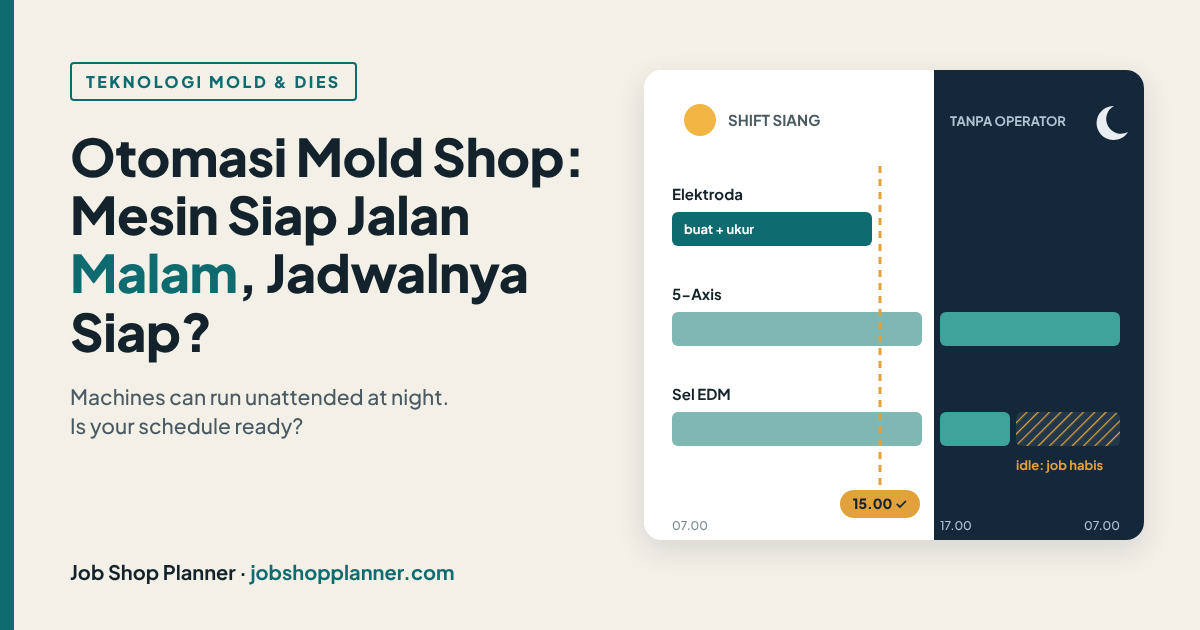
Picture this: your mold shop has just installed an EDM cell with a robot and an electrode magazine. It can work through the night with no operator. At 5 p.m. the day shift goes home. At 9 p.m. the machine stops because the loaded jobs are finished, and the electrodes for the next cavity were never measured. An expensive machine sits idle until morning.
This happens more often than people expect. Automation does open up new working hours: nights and weekends. But those hours are only worth something if there is work that is truly ready to fill them. That is where production planning (PPIC) makes the difference.
The trend: unattended hours as new capacity
In North America, mold shop automation has moved from pilot project to survival strategy. American Mold Builder (AMBA, August 2026) notes that labor shortages and more complex parts are pushing shops toward machining processes that many programmers and many machines can repeat. The focus has shifted from cutting faster to consistent processes that reduce polishing and allow more unattended machining.
Coverage of IMTS 2026 in Modern Machine Shop (June 2026, sponsored content from show organizer AMT) cites a survey indicating that most top-performing shops already run some form of unattended operation, lifting daily machine use from roughly 8.5 hours to about 15 hours. These figures describe leading shops, so treat them as a direction rather than a benchmark.
What does an automated cell look like in a mold shop?
MoldMaking Technology profiled two U.S. mold builders, Decatur Mold and Dynamic Tool, that built their automation step by step. Some highlights:
- EDM cells with hundreds of electrode positions. One cell holds 30 pallets and four carousels with 800 electrode positions in total.
- Standard pallets across processes. A workpiece from the 5-axis cell can move to EDM and be ready to burn in under five minutes, because its position is kept between machines.
- EDM programs from CAM, not typed by hand. Burn locations come straight from software, reducing input errors.
- Many old methods dropped. Decatur says it discarded about 80% of its previous methods when moving to automation, for example machining single inserts on pallets instead of clusters.
A Plastics Machinery & Manufacturing report (July 2025) on the same shop says a pallet system cut setup from about 1.5 hours to about 30 minutes, because the next workpiece is prepared outside the machine. Their goal is to run through a three-day holiday weekend with nobody on site, and they admit they are not there yet. It is an honest reminder that automation is a journey.
The bottleneck moves to preparation
Once machines can run on their own, the constraint moves upstream. What now limits output is everything that must be ready before the shift ends:
- CNC and EDM programs that have been verified or simulated.
- Electrodes that are machined, measured, and loaded into the magazine.
- Pallets and workpieces that are preset.
- Material, tools, and enough tool life for the unattended period.
This means a schedule can no longer be just a job sequence per machine. It must answer: which jobs get loaded at 5 p.m., and is all their preparation finished by 3 p.m.? If electrode making or programming falls behind, night hours that cost a large investment are wasted.
MoldMaking Technology also stresses that the software managing workflow, including scheduling and fixture management, largely determines how efficiently an automated cell runs.
What it means for PPIC in Indonesia
Most mold and die shops in Indonesia do not yet have robot cells. Yet the push is real: Indonesia's Ministry of Industry (May 2026) highlighted reskilling and upskilling programs so the workforce is ready for automation and digitized production. The good news is that "unattended hours" thinking can start without robots, for example EDM jobs left running after hours, or a night shift with minimal staff.
Practical steps to try:
- Map idle hours as capacity. Count break, night, and weekend hours per machine. Plan them as separate capacity, with rules that differ from normal hours.
- Pick jobs that suit the night. Favor long, low-risk operations such as EDM roughing or proven 5-axis finishing programs. Avoid first-off parts, new materials, or unsimulated programs.
- Use a readiness checklist by 3 p.m. Program verified, electrodes measured, pallets preset, tools sufficient. Jobs that fail the checklist stay out of the night queue.
- Schedule preparation as real work. Electrode making, CAM, and presetting need their own slots in the schedule, not "whenever there is time".
- Measure unattended hours actually used. Compare available hours with hours the machine actually cut or burned. Log why it stopped: out of work, alarm, worn tool, or electrode not ready.
- Standardize before buying robots. Uniform workholding and pallets, off-machine presetting, and written machining standards already pay off and form the foundation for later automation.
Closing
Automation promises extra machine hours without adding operators. But shops that have walked this path show the same pattern: machines can run themselves, but they cannot plan themselves. Productive night hours come from a schedule that prepares work during the day, watches the load on bottleneck machines, and keeps preparation from falling behind.
Source note: this article summarizes and paraphrases American Mold Builder (AMBA, August 2026), Modern Machine Shop (June 2026, AMT sponsored content), MoldMaking Technology (coverage of Decatur Mold and Dynamic Tool), Plastics Machinery & Manufacturing (July 2025), and ANTARA News (May 2026). Figures are as reported by the sources and will vary from shop to shop.
Ready to fill machine hours with the right work? Job Shop Planner helps PPIC teams build and level machine schedules, see the load on every machine clearly, and prepare PPIC reports. Clients report that building a production schedule dropped from about 8 hours to about 30 minutes. Learn more at jobshopplanner.com.
Sources:
- American Mold Builder (AMBA), "More Than Shop Rates: How Industry Intelligence Drives Better Business Decisions", August 31, 2026 — https://americanmoldbuilder.com/articles/2026/more-than-shop-rates-how-industry-intelligence-drives-better-business-decisions/
- Modern Machine Shop, "Exploring Automation at IMTS 2026", June 2026 (AMT sponsored content) — https://www.mmsonline.com/articles/exploring-automation-at-imts-2026
- MoldMaking Technology, "Overcoming Barriers to Automation Integration in Precision Moldmaking" — https://www.moldmakingtechnology.com/articles/overcoming-barriers-to-automation-integration-in-precision-moldmaking
- Plastics Machinery & Manufacturing, "Robots put unattended operations within reach for mold makers", July 22, 2025 — https://www.plasticsmachinerymanufacturing.com/55298782
- ANTARA News Yogyakarta, "May Day 2026: Ministry of Industry stresses industrial workforce competence", May 1, 2026 — https://jogja.antaranews.com/berita/825404/may-day-2026-kemenperin-tekankan-penguatan-kompetensi-sdm-industri