Schedule Drift: Why Mold Shop Schedules Slip and How to Rein Them In
Mold & die schedules rarely fail all at once; they drift. Learn what causes schedule drift and 5 PPIC habits that keep delivery dates safe.
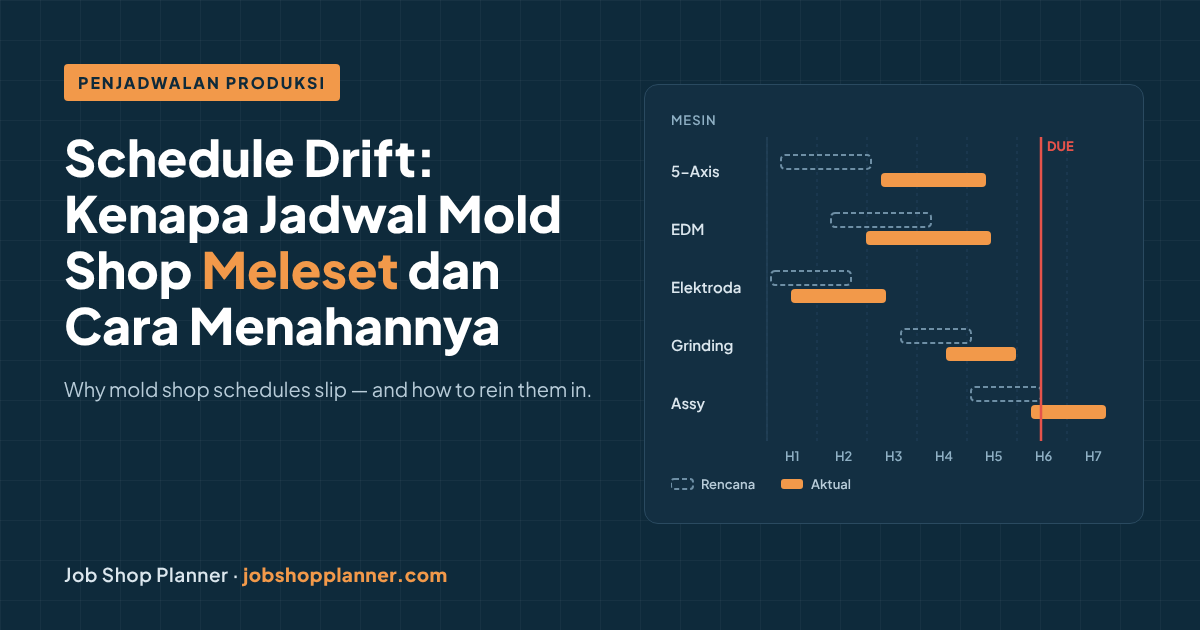
On Monday morning the schedule looks clean. By Wednesday afternoon, a setup on the 5-axis machine has run two hours over, electrodes for EDM are not ready, and the insert material arrives tomorrow. Nothing "big" has broken, yet the mold's delivery date has already moved two days. Trade media call this schedule drift: the gap between plan and shop-floor reality that widens quietly.
For a mold & die PPIC team, drift is more dangerous than a machine breakdown. A breakdown is visible and everyone reacts. Drift happens silently and often surfaces only when the customer calls to ask about the trial date.
Where does drift come from?
Modern Machine Shop (September 2026) profiled two U.S. job shops struggling with exactly this. The causes they named will sound familiar to shops in Indonesia:
- Setups taking longer than planned, especially for new parts or hard materials.
- A key person being absent, for example the only operator who knows a particular 5-axis program.
- Late material or purchased components, forcing a sudden change in job sequence.
In a mold & die shop the list is usually longer: customer design changes (ECNs), rework after trial, electrodes not ready when the EDM is free, and machine-hour estimates that are too optimistic. Each is small. The problem is that they compound, because one mold contains dozens of components waiting for the same machines.
Don't chase every machine, chase the bottleneck
An old Theory of Constraints lesson still applies: a mold's delivery date is set by the busiest resource, not by average utilization across the shop. A classic MoldMaking Technology example describes a shop that needed roughly 100 hours of electrode machining to support 80 hours of EDM work. The real constraint was not the EDM but electrode production. Moving some electrode work to slower, idle machines increased total machine hours, yet the electrodes were finished sooner and the EDM never waited.
The takeaway for PPIC: drift on non-bottleneck machines can often be absorbed. Drift on the bottleneck moves the delivery date immediately, so daily monitoring should focus on the two or three most loaded machines.
Stable or responsive? You need both
When drift appears, the temptation is to rebuild the entire schedule. But a schedule that changes every hour confuses foremen and operators, and trust in the schedule disappears.
Academic research recognizes the same dilemma. A study in the journal Processes (April 2025) on rescheduling flexible job shops after machine breakdowns optimized not only total tardiness but also how far the new schedule deviates from the original one. In other words, a good reschedule finishes on time and avoids scrambling work that is already prepared on the floor.
In practice, many shops use a simple approach:
- A frozen zone of 1–2 days ahead: jobs here change only for major events.
- Periodic rescheduling, for example every morning, based on yesterday's actuals.
- Event-driven rescheduling only for disruptions at the bottleneck or changes in delivery dates.
Lessons from lead-time leaders
MoldMaking Technology's "Leadtime Leaders" feature (March 2026) shows a similar pattern among North American mold builders. One aligns every department, from design to tryout, around a single lead-time target. Another uses velocity scheduling so that many complex components are ready on the assembly milestone date. One shop reported 100% on-time delivery in 2025, with most deliveries early. Another report from the same show described a mold builder that spent two years improving its scheduling practices to spot bottlenecks sooner and make delivery more predictable.
The common thread is not the most expensive machine but discipline: clear milestones, recorded actuals, and bottlenecks made visible early.
What this means for PPIC in Indonesia
Mold & die shops in Indonesia, especially those serving automotive and plastic components, face shorter lead times and frequent design changes. Practical steps you can start this week:
- Measure the drift. Compare plan vs actual per operation for two weeks. Record the cause: setup, material, ECN, rework, people, or machine.
- Name 2–3 bottleneck machines (often EDM, 5-axis, or grinding) and check their load every day.
- Separate estimates from hopes. Update standard machine hours from actual data, not from quotation figures.
- Use milestones per mold: design release, material arrival, core/cavity complete, assembly, trial. Drift at milestones is easier to read than drift across hundreds of operations.
- Agree on a rescheduling rhythm: when the schedule may change, who decides, and how changes reach the foremen.
All of this can start in a spreadsheet. But as active molds and machines multiply, rebuilding the schedule by hand every morning takes hours, and that is exactly where drift slips through.
Closing
No schedule survives contact with reality intact, and that is normal. What separates shops that deliver on time is how quickly they see drift, especially at the bottleneck, and adjust the schedule without throwing the shop floor into chaos.
Want to see machine load and schedule drift sooner? Job Shop Planner helps PPIC teams with scheduling and machine leveling, machine-load visibility, and PPIC reporting. Clients report that building the production schedule dropped from about 8 hours to about 30 minutes. Try the Free Schedule Audit at jobshopplanner.com.
Sources
Figures and company claims in this article come from the sources below. The 2008 MoldMaking Technology article is used as conceptual background.
- Modern Machine Shop — Charting the Course Through Schedule Drift (Sep 2026)
- MoldMaking Technology — Leadtime Leaders: Excellence in Action (Mar 2026)
- MoldMaking Technology — Mold Builders Exhibiting at PTXPO 2026 (Mar 2026)
- Wu, Zheng & Yin — Dynamic Scheduling for Multi-Objective Flexible Job Shops with Machine Breakdown by Deep Reinforcement Learning, Processes 13(4):1246 (Apr 2025)
- MoldMaking Technology — Constraint Management: How to Break a Roadblock (2008)